Is Ceramic Tint Worth It for Florida Daily Driving 2026?
Is ceramic tint worth it for Florida daily driving in 2026? For most Cape Coral and Southwest Florida drivers, yes. Between near year-round heat, intense UV exposure, and long commutes under open sky, window tint is one of the most practical upgrades you can make to improve comfort and protect your interior. Ceramic window tint is consistently the top-performing film category for heat and infrared rejection in Florida’s climate, which is why it is the option many daily commuters and car enthusiasts want to understand before investing. The real question is whether the higher price over standard dyed film is justified for your specific vehicle, budget, and driving routine. In most cases, ceramic tint pays off in cooler cabin temps, reduced glare fatigue, better interior protection, and longer film life, but the “right” choice still depends on your daily sun exposure, vehicle glass area, and the film brand and installer you choose. This guide breaks down the real-world differences so you can choose confidently.
Table of Contents
- What Is Ceramic Window Tint and How Is It Different From Standard Dyed Film?
- Why Florida’s Climate Makes Ceramic Tint the Smart Choice for Daily Drivers in 2026
- Ceramic Tint vs Dyed Tint vs Carbon Tint: Which Performs Best for Cape Coral Daily Drivers?
- Real-World Benefits of Ceramic Window Tint for Southwest Florida Drivers and Commuters
- How Much Does Ceramic Window Tint Cost in Cape Coral and the Fort Myers Area?
- Florida Auto Tint Laws in 2026: What Cape Coral Drivers Need to Know Before Tinting
- How to Choose the Right Ceramic Tint Installer in Cape Coral and Southwest Florida (Plus FAQs and Next Steps)
What Is Ceramic Window Tint and How Is It Different From Standard Dyed Film?
Direct answer: ceramic window tint uses advanced ceramic or nano-ceramic particles to block heat and infrared energy without using metal, while standard dyed tint relies more on visible darkening and dye layers, which typically deliver less heat rejection and can fade faster in Southwest Florida sun.
How ceramic tint works (in plain language)
Sunlight carries more than brightness. It also carries heat energy, including infrared (IR). Ceramic films are engineered to target a wider portion of that heat energy compared to basic dyed films. While the exact performance depends on the film series and the VLT you choose, ceramic is widely considered the best window tint for Florida daily driving because it can reduce heat load without forcing you to go extremely dark.
That matters in Cape Coral and surrounding areas like Fort Myers, Bonita Springs, Estero, Naples, Lehigh Acres, and Pine Island where your vehicle can sit in full sun for hours. If your tint only looks dark but does not manage heat well, your interior still heats up aggressively and your AC has to work harder.
How standard dyed tint differs
Dyed films are typically the entry-level option. They darken the glass and cut glare, and they can help with some heat reduction, but they generally do not reject IR nearly as effectively as ceramic. In Florida heat, a dyed film may “feel” like it helps because the cabin looks darker, but the difference becomes obvious on long commutes and during summer parking.
Over time, dyed films can be more prone to color shift, hazing, and visible aging, especially in high-UV environments. Not all dyed films fail quickly, but Florida’s sun is a stress test.
What “carbon” tint means
Carbon tint is often positioned between dyed and ceramic. Many carbon films improve color stability compared to basic dyed film and can offer solid heat rejection. For many budgets, carbon can be a strong middle ground. But for drivers specifically searching “ceramic vs dyed tint Florida heat” or “is ceramic tint worth it Florida 2026,” the deciding factor is usually peak comfort and long-term value under relentless sun exposure.
Why Florida’s Climate Makes Ceramic Tint the Smart Choice for Daily Drivers in 2026
Direct answer: Southwest Florida’s intensity and consistency of sun exposure makes heat management and UV protection more valuable, more days of the year, than in most states. Ceramic tint is designed to deliver that performance with better stability over time.
Southwest Florida is a “daily sun” region, not a seasonal one
Cape Coral and Fort Myers drivers do not just deal with “summer heat.” You deal with strong sun much of the year, plus humid air that makes your cabin feel hotter and more uncomfortable. Even short trips can be unpleasant when your steering wheel, seats, and seat belt buckles heat up fast.
Because the exposure is frequent, the benefits of a high-performing film compound. The more time you spend on Del Prado Blvd, Veterans Pkwy, Pine Island Rd, US-41, Daniels Pkwy, I-75, or driving between Lee County and Collier County, the more the film’s heat and glare performance matters.
UV and interior damage add up quickly in Florida
UV contributes to faded upholstery, dried leather, cracked dashboards, and general interior aging. High-quality automotive films are commonly designed to block up to 99% of UV radiation, which is a major reason ceramic window tint in Cape Coral FL is viewed as a protection upgrade, not just a cosmetic one.
For daily drivers who keep vehicles longer than 3 to 5 years, protecting the interior can preserve resale value and reduce how “aged” the car feels.
2026 vehicles still benefit, even with modern factory glass
Many modern vehicles have factory-treated glass that helps with some UV or glare, but it is not the same as a full window film system that targets infrared heat and provides consistent protection across side windows and rear glass. If you have a panoramic roof, large windshield area, or a vehicle that sits outside at work, ceramic tint becomes even more relevant.
Ceramic Tint vs Dyed Tint vs Carbon Tint: Which Performs Best for Cape Coral Daily Drivers?
Direct answer: ceramic tint is typically the top performer for heat and IR rejection and long-term stability, carbon is a strong mid-tier choice, and dyed tint is usually the budget option best suited for drivers prioritizing appearance and glare reduction over maximum thermal comfort.
Comparison “table” for Florida daily driving (2026)
Standard Dyed Window Tint
- Heat rejection in Florida: Basic to moderate, depends heavily on darkness and film quality.
- UV protection: Often high on reputable brands, but confirm the spec and warranty.
- Infrared (IR) rejection: Limited compared to carbon and ceramic.
- Glare reduction: Good, especially at lower VLT.
- Color stability: More likely to fade or shift in Southwest Florida sun over time.
- Signal interference: Typically none (non-metal), but confirm film type.
- Approx. price and value: Lowest upfront cost, shorter performance lifespan for many Florida drivers.
Carbon Window Tint
- Heat rejection in Florida: Moderate to strong, usually better than dyed.
- UV protection: Often high on reputable brands.
- Infrared (IR) rejection: Improved vs dyed, typically not as strong as premium ceramic.
- Glare reduction: Very good.
- Color stability: Generally better resistance to fading than dyed film.
- Signal interference: Typically none (non-metal).
- Approx. price and value: Mid-range cost with solid long-term value for many commuters.
Ceramic Window Tint (example: LLumar CTX and IRX series)
- Heat rejection in Florida: Strong to top-tier, especially in higher-performing series.
- UV protection: Commonly rated up to 99% UV protection on premium lines.
- Infrared (IR) rejection: Designed for high IR reduction, key for “Florida heat” comfort.
- Glare reduction: Excellent, with more comfort even when not extremely dark.
- Color stability: Typically excellent stability and clarity for long-term Florida exposure.
- Signal interference: Typically none because ceramic films are non-metal.
- Approx. price and value: Highest upfront cost, often best long-term value for daily drivers who keep vehicles and drive in sun frequently.
LLumar IRX vs LLumar CTX for Cape Coral daily drivers (structured comparison)
Direct answer: LLumar IRX is commonly chosen when maximum heat and IR rejection is the priority, while LLumar CTX is a high-quality ceramic option that balances performance and price for many Southwest Florida commuters.
- Heat and IR rejection: IRX is positioned as top-tier ceramic for stronger IR performance; CTX is strong ceramic performance at a lower tier.
- Optical clarity: Both are designed for clear, low-haze appearance when professionally installed and properly cured.
- VLT options: Both typically offer multiple VLT choices so you can match comfort, style, and Florida law compliance.
- Warranty coverage: Both are backed by manufacturer warranties on eligible installs. Always confirm the exact warranty details for your vehicle and film selection with your dealer.
- Best fit by vehicle and budget: IRX often fits drivers with long commutes, lots of outdoor parking, large glass areas (SUVs, trucks), or high sensitivity to heat. CTX often fits drivers who want ceramic performance and durability with a more value-focused budget.
Real-World Benefits of Ceramic Window Tint for Southwest Florida Drivers and Commuters
Direct answer: ceramic tint helps your cabin feel noticeably less harsh in sun, reduces glare fatigue, helps protect skin and interior materials from UV, and can outlast cheaper films under Florida exposure when installed correctly.
1) More comfortable daily driving in Cape Coral heat
Drivers usually describe ceramic tint as making the cabin feel “less baked” after parking and “less punishing” during mid-day driving. You will still have hot days, but the heat load coming through side glass and rear glass can be reduced, which makes the AC feel more effective and the drive less draining.
This matters for commuting between Cape Coral and Fort Myers, running errands across Lehigh Acres, or making longer drives toward Estero, Bonita Springs, or Naples. It also matters for rideshare drivers and people who work in the field and are in and out of the car all day.
2) Strong UV protection for you and your interior
High-quality films are commonly designed to block up to 99% of UV rays. That supports skin protection and helps reduce fading and drying of interior surfaces. If your vehicle has leather or soft-touch dashboards, Florida UV is one of the fastest ways to age that interior.
3) Glare reduction that lowers eye strain
Glare is not just annoying. It increases fatigue and reduces comfort, especially on bright afternoons over water, near open lots, or when the sun is low on the horizon. Ceramic films deliver strong glare reduction while still maintaining a premium, clear look when you choose an appropriate VLT.
4) Long-term durability in Florida’s sun and humidity
The phrase “tint failure” usually means purple fading, bubbling, peeling edges, or haze. The risk is higher with low-quality film and poor installation, but climate matters too. Southwest Florida heat cycles and humidity can expose weaknesses quickly. Choosing a premium ceramic film and a proven installer is one of the easiest ways to avoid re-tinting sooner than expected.
5) No metal, so no signal interference in modern cars
Many drivers search “will ceramic tint interfere with GPS” because older metallic films could cause issues. Ceramic tint is non-metal, so it is generally chosen specifically to avoid interference with GPS, Bluetooth, cellular signal, and modern vehicle electronics. If your vehicle has advanced driver assistance sensors or built-in antennas, it is still smart to discuss placement and film choices with your installer.
How Much Does Ceramic Window Tint Cost in Cape Coral and the Fort Myers Area?
Direct answer: ceramic window tint costs more than dyed film, but the final price depends on vehicle type, number of windows, film series (for example, LLumar CTX vs IRX), and the quality of the install and warranty support.
Typical price ranges (what affects your quote)
If you search “ceramic tint Fort Myers FL” or “window tinting near me Cape Coral,” you will see a wide range of pricing. That is normal. A 2-door coupe, a full-size SUV with lots of glass, and a truck with large rear glass can require different film coverage and labor time.
- Vehicle size and glass complexity: More windows and larger glass increases material and labor.
- Film level: Top-tier ceramic (like LLumar IRX) is typically priced higher than ceramic value tiers (like CTX) and dyed film (like ATC).
- Windshield options: Some drivers choose a clear heat-rejection film on the windshield for comfort while staying compliant, which can affect price.
- Installer quality and warranty handling: A shop that stands behind its work and handles warranty support is part of the value.
Long-term value: why the “cheaper option” can cost more
In Florida, re-tinting is common when a low-tier film fades, turns purple, bubbles, or simply does not deliver the comfort the driver expected. Paying once for a premium ceramic film from a trusted installer can be more cost-effective than paying twice for an entry-level solution that fails early or disappoints in real-world heat.
Local note for Southwest Florida: If you are comparing quotes in Cape Coral, Fort Myers, Bonita Springs, Estero, Naples, or surrounding Lee County and Collier County areas, ask what film series is being installed, whether it is backed by a manufacturer warranty, and what is included (full rear glass coverage, windshield film options, and installation quality standards).
Florida Auto Tint Laws in 2026: What Cape Coral Drivers Need to Know Before Tinting
Direct answer: Florida has specific legal Visible Light Transmission (VLT) limits by window location and vehicle type, and you should choose a film and shade that is both comfortable and compliant.
Know VLT before you choose shade
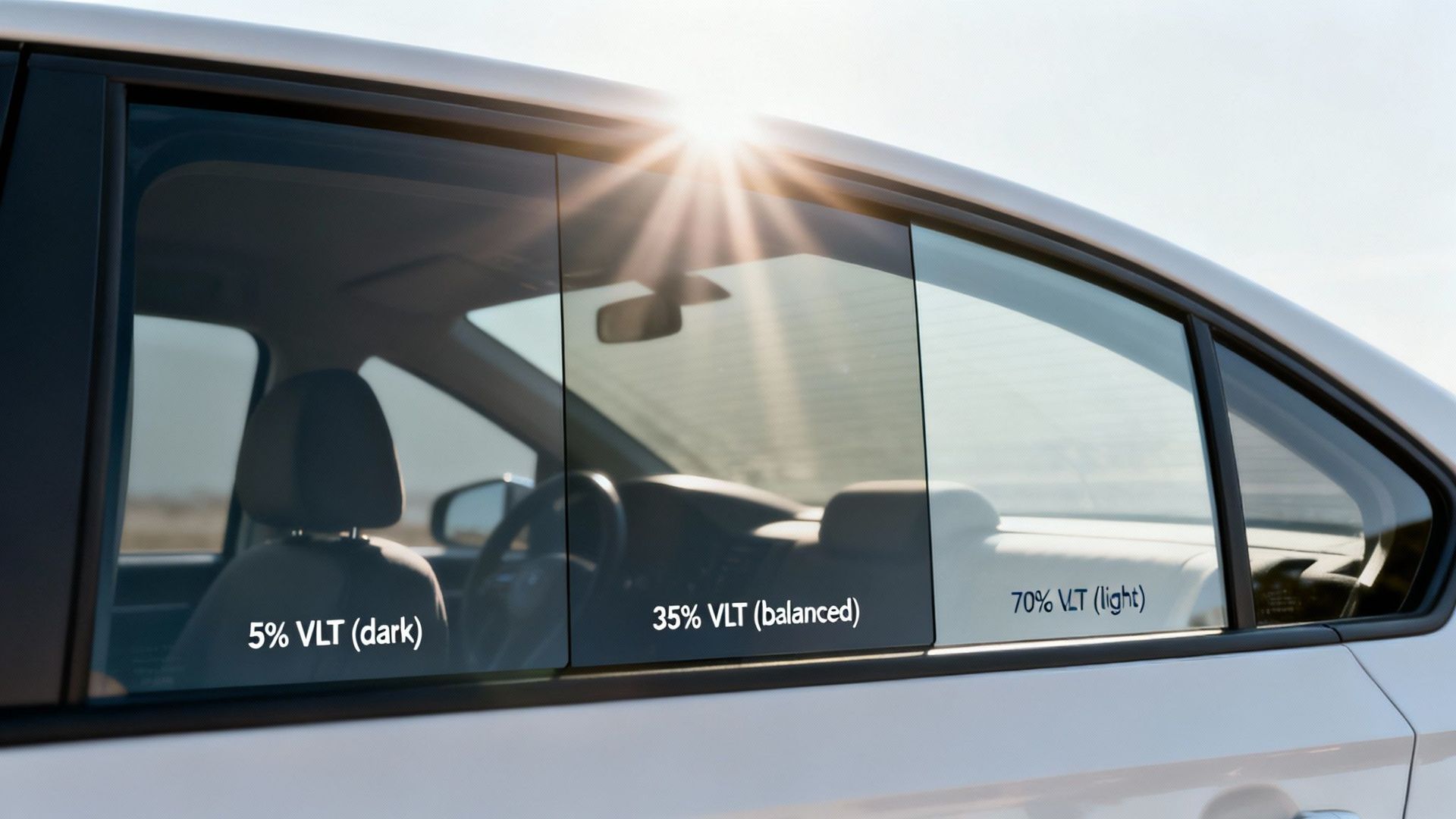
VLT is the percentage of visible light that passes through the window. Lower VLT means darker tint. Florida tint enforcement can vary by area, but legal limits are still the baseline for a stress-free daily driver.
Because laws can change and interpretations can vary, confirm the current Florida requirements for your vehicle type at the time you tint. A professional shop should be able to recommend compliant options that still deliver strong comfort.
Practical compliance tips for Southwest Florida drivers
- Prioritize performance over darkness: With ceramic, you can often get better comfort without going extremely dark.
- Consider a clear windshield film option: Some drivers choose a clear, heat-rejecting film for the windshield area where allowed and appropriate.
- Ask for a meter reading: Your final VLT depends on factory glass plus film. A reputable installer can discuss expected readings.
How to Choose the Right Ceramic Tint Installer in Cape Coral and Southwest Florida (Plus FAQs and Next Steps)
Direct answer: the film matters, but the installer often determines whether you end up with perfect edges, clean clarity, long-term durability, and a warranty-backed result.
What to look for in a ceramic tint installer
- Authorized, transparent film lineup: You should be told exactly what you are getting, such as LLumar IRX Series (top-tier ceramic), CTX Series (ceramic), ATC Series (dyed), and Air Series (clear).
- Proven local reputation: Look for consistent 5-star reviews and photo evidence of clean installs on real vehicles.
- Warranty and aftercare support: Ask how warranty claims are handled and what curing expectations are in Southwest Florida humidity.
- Clean work environment: Dust control and process discipline matter for tint clarity.
- Clear, written estimate: The best shops explain film series, VLT options, what is included, and pricing.
Why many Cape Coral drivers choose a trusted LLumar dealer
For drivers searching “LLumar ceramic tint Cape Coral” or “ceramic window tint Cape Coral FL,” the goal is usually premium comfort with no drama: strong heat and IR management, up to 99% UV protection on qualifying films, no signal interference, and a manufacturer warranty. When installed by an experienced local team, premium ceramic tint becomes a “set it and forget it” upgrade that makes every drive feel better.
Tints and Beyond is a top-rated Cape Coral auto spa and trusted LLumar dealer offering the full LLumar auto window tint lineup including IRX, CTX, ATC, and Air, plus services like LLumar Paint Protection Film, ceramic coating, auto wraps, auto detailing, paint correction, headlight restoration, and tail light tinting. If you want ceramic tint that performs on Florida roads and looks flawless, the combination of film quality and installation quality is the difference maker.
FAQ (2026): Ceramic tint in Cape Coral and Southwest Florida
Is ceramic window tint really worth the extra cost for Florida daily drivers?
For most daily drivers in Southwest Florida, yes. It offers stronger heat and IR rejection, UV protection, and long-term durability. If you drive often or park outside, the comfort and longevity usually justify the cost.
How much cooler does ceramic tint keep a car in Cape Coral and Southwest Florida heat?
It depends on film type, VLT, and vehicle glass, but most drivers feel noticeably less heat and faster AC cooling, especially on long drives or after parking in the sun.
What is the difference between LLumar IRX Series and CTX Series ceramic tint?
IRX is the premium option with higher IR/heat rejection, while CTX offers strong ceramic performance at a more budget-friendly level. Choice depends on comfort needs and budget.
Does ceramic tint block UV rays better than dyed or carbon film?
High-quality films can all block strong UV levels, but ceramic is preferred because it combines UV protection with better heat and IR rejection. Always check the exact film specs.
Will ceramic tint interfere with GPS, Bluetooth, or phone signal?
No, ceramic tint is non-metallic and designed to avoid signal interference, making it safe for modern electronics and antennas.
How long does ceramic window tint last in Southwest Florida heat and humidity?
With quality film and proper installation, it’s built for long-term durability and color stability, often lasting significantly longer than dyed films in harsh climates.
What are Florida’s legal tint limits for cars and trucks in 2026?
Florida sets VLT limits based on window position and vehicle type. Always confirm current laws before installation to ensure compliance.
Can I get ceramic tint on my home or business windows in Cape Coral?
Automotive ceramic tint is different from residential/commercial films. Many installers offer architectural options suited for homes and businesses based on energy and safety needs.
How much does ceramic window tinting cost for a car in Cape Coral or Fort Myers?
Cost varies by vehicle size, film type, and options like windshield tint. The best approach is getting a written quote based on the exact film and coverage.
What makes LLumar ceramic tint different from other brands?
LLumar is known for consistent quality, optical clarity, strong performance options, and reliable warranties when installed by authorized dealers.
Conclusion and call to action for Cape Coral drivers
If you drive in Cape Coral, Fort Myers, Bonita Springs, Estero, Naples, Lehigh Acres, Pine Island, or anywhere across Lee County and Collier County, ceramic tint is one of the most practical, highest-performing upgrades you can make for Florida daily driving in 2026. It is built to manage the heat and infrared load that makes Southwest Florida commutes exhausting, while also helping protect your interior from relentless UV exposure. Cheaper dyed films can look fine at first, but they are more likely to disappoint in real heat performance and can be more prone to fading, bubbling, or early failure under Florida sun and humidity.
For the best long-term value, the key is pairing the right film series with a 5-star rated installer who delivers clean edges, consistent clarity, and warranty-backed results. Tints and Beyond is Cape Coral’s premier auto spa and trusted LLumar dealer, proudly serving drivers across Cape Coral, Fort Myers, Bonita Springs, Estero, Naples, and the greater Southwest Florida market with LLumar IRX and CTX ceramic tint options, plus ATC and Air series choices. To get a personalized recommendation and transparent pricing, book an appointment or request a free estimate with Tints and Beyond for professional ceramic window tinting designed for Florida roads.